
Scandinavian knives
Scandinavian knives are a benchmark in the world of outdoor knives. They are known for a philosophy that prioritizes functionality, simplicity, and reliability. These knives are designed to withstand the challenges of the Nordic wilderness. They have been used by Nordic peoples for centuries, and their shape remains largely the same today as it was in the past. The Scandinavian knife is a practical and straightforward tool for nature and hunting. Hunters, fishermen, and reindeer herders from the far North carry a knife constantly and use it daily for countless activities.
#ShowMore#
Tradition vs. Modernity
Two basic types of Scandinavian knives have been known since time immemorial:
- Puukko – A Finnish term for a general-purpose (working) knife that is an essential part of Nordic culture. It is a small to medium-sized knife used for precise work such as wood carving, portioning food, skinning small game, and similar tasks. The typical blade length is around 7 to 12 cm. A pocket version of this knife is called the taskupuukko.
- Leuku – The traditional knife of the Sami (Lappish) people, designed as a robust and heavy tool for the harsh wilderness. It is often described as a cross between a large knife and a small axe. It is used for heavy-duty tasks such as chopping, splitting wood, limbing branches, or portioning large game. It has a substantially larger and thicker blade. The blade length ranges from 13 to 30 cm and more.
Traditional Scandinavian knives are made by brands like Ahti, Eräpuu, Lappi, and Polar from Finland, Helle from Norway, and Wood Jewel from Lapland.
📌 Interesting fact: The buiku knife fills the gap between the puukko and leuku. It is essentially a slightly smaller, easier-to-handle version of the leuku. It is suitable for splitting wood or other heavier tasks where the strength of a leuku is useful, but the leuku itself would be too large and unwieldy.
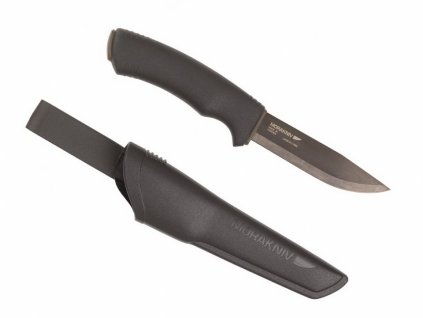
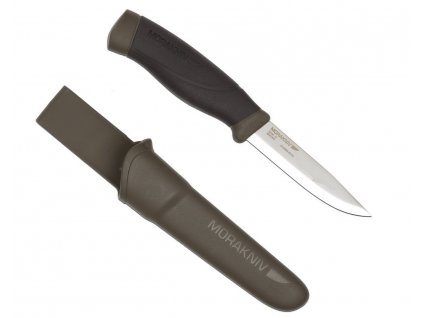
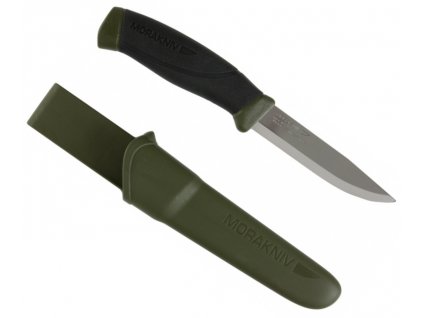
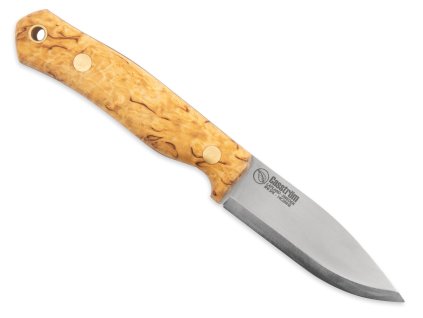
Scandinavian knives are characterized by the use of natural materials. While these still dominate the production of Nordic knives, modern technologies and materials such as thermoplastic for handles and modern steels for blades are also being used. The renowned Swedish brand Morakniv is a benchmark in modern Scandinavian knives. Their knives are tough and reliable. Modern handles can also be found on some Casström knives.
The Scandinavian Grind (Scandi Grind)
The blade maintains its full thickness for most of its height, and the bevel (grind) usually starts in the lower half to form the edge. The Scandinavian grind does not have a secondary bevel (micro-bevel) and tapers uniformly to the cutting edge itself (essentially forming a V-shape). The advantages are blade strength and ease of sharpening. It has excellent properties for wood processing and carving. Simply put, the Scandi grind is the best choice for woodworking. Many experienced woodsmen believe that the Scandinavian grind, with a thickness of around 3 mm, is one of the most suitable for creating feather sticks, which is undoubtedly one of the reasons for the huge popularity of Morakniv knives. For thicker blades (4 mm and more), the main drawback can be compromised cutting performance.
Advantages of the Scandinavian Grind:
- ✔️ Excellent cutting properties
- ✔️ Great for woodworking
- ✔️ Simple sharpening technique
Disadvantages of the Scandinavian Grind:
- ➖ Requires grinding a larger surface area when sharpening compared to grinds with a secondary bevel.
Accessories and Knife Care
Subsequent care is an important part of working with knives. Every knife should be sufficiently sharp to fulfill its basic function. To ensure your knife remains functional for longer, regular maintenance is essential.
Product sorting
List of products
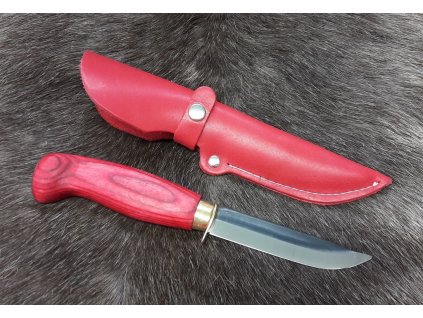
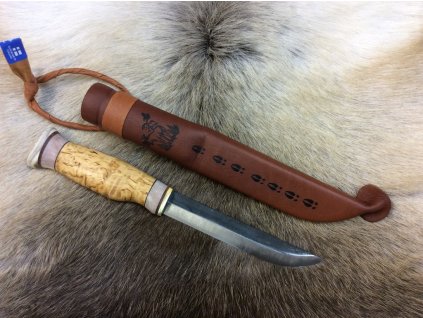

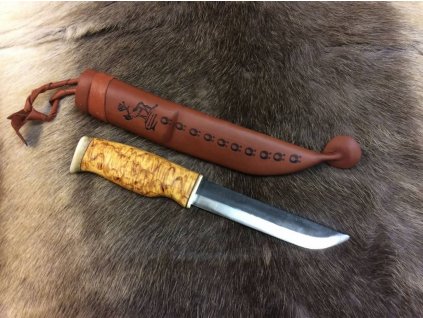
Traditional Lapland leuku with a 14,5 cm carbon steel blade. The blade from 80CrV2 carbon steel excels in toughness, is sharp and robust, which makes it ideal for outdoor use...
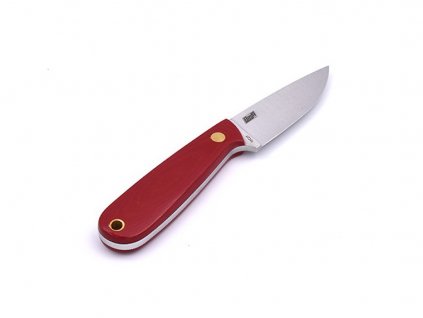




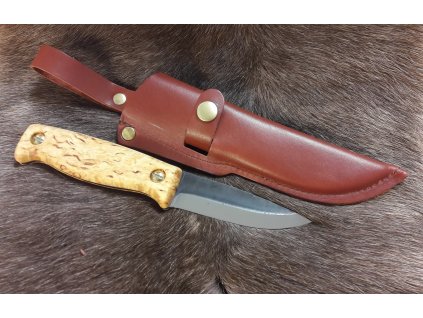
What is the difference between a leuku and a puukko?
The fundamental difference is size. The Puukko has a blade length of 7 to 12 cm. Leuku knives are more robust, with a blade length of 13 to 30 cm. While the puukko is used for fine work, the leuku is utilized for heavy-duty tasks.
How do you properly sharpen a Scandinavian grind?
Sharpening the Scandinavian grind is surprisingly simple and effective due to its specific geometry. Unlike other types of knives where you must constantly maintain the correct angle, the Scandi grind's shape makes it easier. When sharpening on a stone, you just need to keep the entire bevel flat against the stone.